Sitemap
A list of all the posts and pages found on the site. For you robots out there is an XML version available for digesting as well.
Pages
Posts
Future Blog Post
This post will show up by default. To disable scheduling of future posts, edit config.yml and set future: false.
Blog Post number 4
This is a sample blog post. Lorem ipsum I can’t remember the rest of lorem ipsum and don’t have an internet connection right now. Testing testing testing this blog post. Blog posts are cool.
Blog Post number 3
This is a sample blog post. Lorem ipsum I can’t remember the rest of lorem ipsum and don’t have an internet connection right now. Testing testing testing this blog post. Blog posts are cool.
Blog Post number 2
This is a sample blog post. Lorem ipsum I can’t remember the rest of lorem ipsum and don’t have an internet connection right now. Testing testing testing this blog post. Blog posts are cool.
Blog Post number 1
This is a sample blog post. Lorem ipsum I can’t remember the rest of lorem ipsum and don’t have an internet connection right now. Testing testing testing this blog post. Blog posts are cool.
portfolio
Mechanical Design & Digital Engineering
Mechanical modelling and simulation with modern 3D engineering tools.
Mechatronics & Experimental Engineering
Mechatronics experimentation and end-to-end experimental workflows for robotic systems.
Perception & Learning (Future Integration)
Training in image processing and reinforcement learning for future integration into robotics.
publications
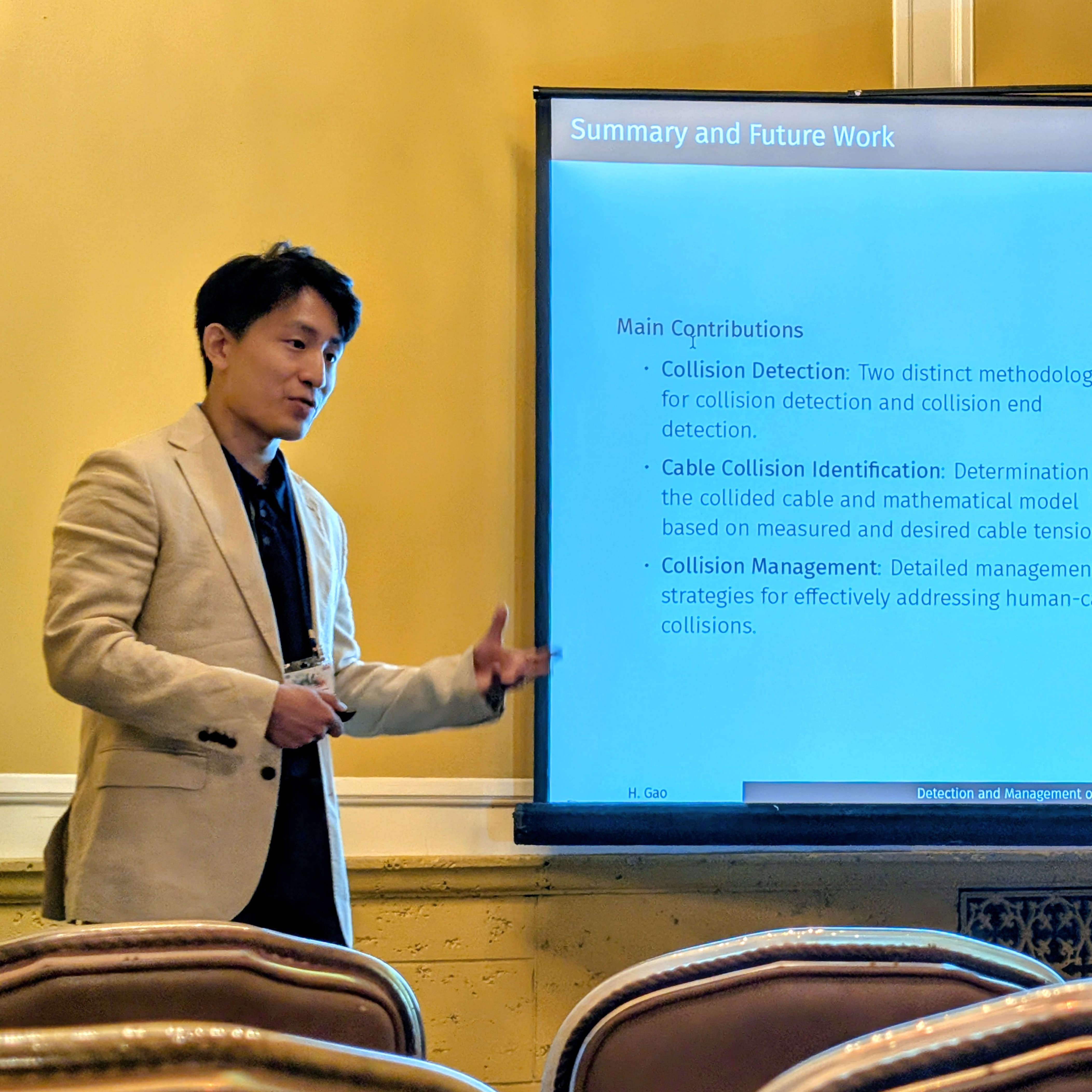
Detection and Management of Human-Cable Collision in Cable-Driven Parallel Robots
Published in IEEE Robotics and Automation Letters, 2024
This work is the first to propose and experimentally validate a human-cable collision management strategy based on cable sagging in Cable-Driven Parallel Robots. In addition, it formally states the problem of collision cable identification and introduces a mathematical solution to address it.
Recommended citation: H. Gao, C. Chevallereau, and S. Caro. (2024). "Detection and Management of Human-Cable Collision in Cable-Driven Parallel Robots." IEEE Robotics and Automation Letters. Vol. 9, No. 12, pp. 11698-11705. doi: 10.1109/LRA.2024.3487051.
Download Paper | Download Slides | Experiment Video
Enhancing Safety in Collaborative Cable-Driven Parallel Robots: Contact Distinction and Management for Carrying Tasks
Published in IEEE Transactions on Automation Science and Engineering, 2025
This paper proposes a cable tension–based metric for detecting contact events in Cable-Driven Parallel Robots (CDPRs), distinguishing different contact scenarios, and implementing tailored management strategies to enhance safety during carrying tasks.
Recommended citation: H. Gao, C. Chevallereau, and S. Caro. (2025). "Enhancing Safety in Collaborative Cable-Driven Parallel Robots: Contact Distinction and Management for Carrying Tasks." IEEE Transactions on Automation Science and Engineering (T-ASE), vol. 22, pp. 18860-18874, 2025.
Download Paper | Experiment Video
Advancements in Human-Cable Collision Detection and Management in Cable-Driven Parallel Robots
Published in The Seventh International Conference on Cable-Driven Parallel Robots (CableCon 2025), Hong Kong, China, 2025
This paper presents an advanced method for detecting human-cable collisions in Cable-Driven Parallel Robots within 100 ms and reducing the collided cable tension within 1 s to ensure safety. The system also restores the tension 1 s after the collision ends, enabling responsive and safe human-robot interaction.
Recommended citation: H. Gao, C. Chevallereau, and S. Caro. (2025). "Advancements in Human-Cable Collision Detection and Management in Cable-Driven Parallel Robots." The Seventh International Conference on Cable-Driven Parallel Robots (CableCon 2025), Jul 2025, Hong Kong, China. ⟨hal-04912207v1⟩.
Download Paper | Download Slides | Experiment Video
A Comprehensive Framework for Safety and Collaborative Management of Physical Human–Robot Interaction in Cable-Driven Parallel Robots
Under Review
This manuscript proposes a unified, feasibility-aware framework for safe and effective physical human–robot interaction (pHRI) in cable-driven parallel robots (CDPRs). The approach jointly manages human–cable and human–moving-platform (MP) contacts by combining collided-cable stiffness reduction with MP-level elasto-plastic trajectory compliance, while a feasibility-aware safety manager monitors wrench-feasible conditions and prevents workspace failure under sensing and estimation uncertainties. Experiments on a large-scale CDPR demonstrate safe contact handling, continued task execution after collisions, and favourable collaborative behaviour, with an analysis of the associated energy implications.
Input-to-State Robustness Control for Human–Cable Interaction in Cable-Driven Parallel Robots
Under Review
This paper develops a collision-aware control strategy for cable-driven parallel robots (CDPRs) during human–cable interaction. We propose a rapidly exponentially input-to-state stable Control Lyapunov Function (RES–ISS–CLF) controller and augment it with a QP-based tension distribution layer that enforces unilateral cable constraints while applying a smooth, time-varying upper-bound reduction on the contacted cable. The method is evaluated in a cable-wrapping simulator with an arm-like obstacle and shows stable tracking and improved post-contact behaviour compared with PID and CLF–QP baselines.
Recommended citation: R. Keskin, H. Gao, C. Chevallereau, and S. Caro. “Input-to-State Robustness Control for Human–Cable Interaction in Cable-Driven Parallel Robots.” Submitted to the European Control Conference (ECC), 2026.
Download Paper
talks
Talk 1 on Relevant Topic in Your Field
This is a description of your talk, which is a markdown files that can be all markdown-ified like any other post. Yay markdown!
Conference Proceeding talk 3 on Relevant Topic in Your Field
This is a description of your conference proceedings talk, note the different field in type. You can put anything in this field.
teaching
Computer Aided Design (CATIA V5)
Graduate course, École Centrale de Nantes, 2025
I taught this undergraduate engineering module in French through lectures and hands-on tutorials using CATIA V5. The course covered fundamental CAD methods for mechanical design, including modelling, detailing, assemblies, and introductory simulation concepts.

Conception de mécanique (CAO/CAD) — 3DEXPERIENCE
Undergraduate course (L1), Nantes Université — IUT de Nantes (GMP), 2025
I delivered this L1 undergraduate engineering module in French as part of my ATER appointment at Nantes Université (IUT de Nantes, GMP). The course introduced computer-aided mechanical design (CAO/CAD) using 3DEXPERIENCE and established core skills in parametric modelling and engineering assemblies.
Chaîne numérique — 3DEXPERIENCE Digital Engineering Workflow
Graduate course (M1/M2), Nantes Université — IUT de Nantes (GMP), 2025
I delivered this graduate-level module in French for M1/M2 engineering students. The course focused on end-to-end digital engineering workflows in 3DEXPERIENCE, from modelling to simulation and validation, with applications to robotics and equipment design.